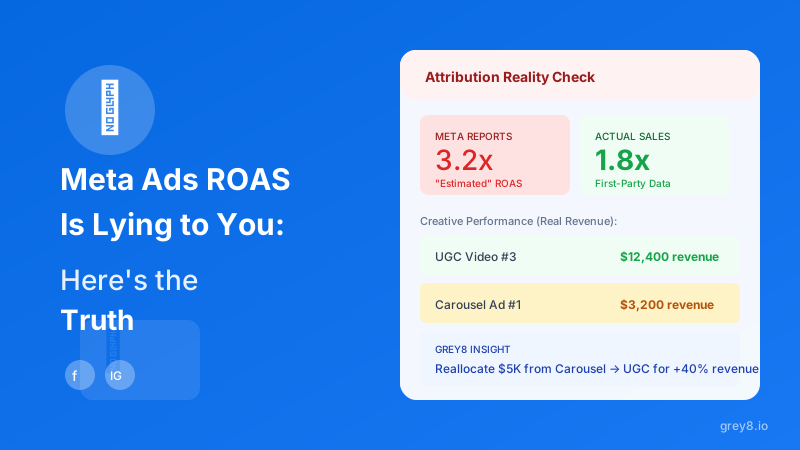
Remember when your Meta Ads dashboard showed every conversion, every customer journey, every touchpoint? iOS 14.5 ended that. Now Meta is guessing—and their guesses are systematically inflated. If you're still trusting reported ROAS, you're making decisions on fantasy data.
The Attribution Crisis: Post-iOS14, Meta can only track about 60% of conversions deterministically. The other 40%? Modeled estimates. And models are optimistic.
1. Modeled Conversions vs Real Conversions
When someone opts out of tracking on iOS, Meta can't see if they converted. So Meta uses statistical modeling to estimate conversions based on patterns from users who are tracked. The problem? These models systematically over-attribute.
Compare Meta-reported conversions to your actual revenue platform. For most advertisers, Meta over-reports by 30-50%. If your dashboard shows a 3:1 ROAS, your real ROAS is probably closer to 2:1—or worse.
Grey8 Solution: We automatically reconcile Meta-reported conversions with your actual sales data from Shopify, Stripe, or QuickBooks. You see both numbers—and the gap between them.
2. View-Through Attribution Window
Meta's default attribution counts a conversion if someone saw your ad (didn't even click) and then converted within the next day. This "view-through" attribution is essentially taking credit for brand awareness you may have built through other channels.
The problem compounds with retargeting. If someone visits your site organically, you retarget them, they see the ad but don't click, then return directly and buy—Meta claims that conversion. You pay for an ad that did nothing.
The Test: Change your attribution window to "1-day click" only. Your reported ROAS will drop 20-40%. That's how much credit Meta was taking for conversions that would have happened anyway.
Grey8 tracks multiple attribution windows simultaneously and shows you the variance. When "7-day click, 1-day view" reports 3x the conversions of "1-day click only," you know exactly how inflated your metrics are.
3. Conversion Lift Studies
This is the only way to measure true incrementality on Meta. A conversion lift study splits your audience into test and control groups—people who see your ads versus people who don't—and measures the actual difference in conversion rates.
The results are usually humbling. Most advertisers discover their ads are only incrementally responsible for 40-60% of attributed conversions. The rest would have converted anyway.
Running lift studies manually is expensive and complex. Grey8 uses holdout modeling and geo-experiments to estimate incrementality continuously, showing you what portion of your Meta-attributed conversions are actually caused by your ads.
4. Server-Side Event Quality Score
The Conversion API (server-side tracking) was supposed to solve iOS 14 attribution loss. It does help—but only if implemented correctly. Most advertisers set it up wrong, sending duplicate events, missing parameters, or failing to match users properly.
Meta gives you an "Event Match Quality" score, but it's buried in the Events Manager and most people ignore it. A score below 6.0 means your server-side events aren't matching users properly, so they're not improving attribution.
Pro Tip: Event Match Quality above 7.0 is minimum viable. Above 8.5 is excellent. Check yours now—it's probably lower than you think.
Grey8 monitors your Event Match Quality score and alerts you when it drops. We also compare browser-pixel conversions to CAPI conversions to detect implementation issues before they cost you thousands in misattributed spend.
5. Blended Marketing Efficiency Ratio (MER)
Since platform attribution is broken, smart advertisers shifted to blended metrics. MER is simple: total revenue divided by total marketing spend, across all channels.
MER doesn't tell you which channel is working—but it tells you if your overall marketing is profitable. And unlike ROAS, it can't be inflated by attribution games.
Grey8 calculates blended MER automatically by connecting all your ad platforms and revenue sources. You see platform-reported ROAS alongside blended MER, revealing exactly how much each platform is over-claiming.
Navigating Post-Privacy Attribution
iOS 14 didn't break Meta Ads—it broke Meta Ads reporting. The platform still works, but you can no longer trust what the dashboard tells you. Every metric is modeled, estimated, or partially blind.
The solution isn't to stop using Meta Ads. It's to stop trusting Meta's attribution and start measuring performance through multiple lenses:
- Compare Meta-reported conversions to actual sales data
- Test different attribution windows to see the variance
- Run conversion lift studies or use holdout modeling
- Monitor Event Match Quality for CAPI implementation
- Track blended MER as your source of truth
Grey8 automates all of this. Connect your Meta Ads account alongside Shopify, Stripe, or QuickBooks, and we automatically calculate true conversion reconciliation, blended MER, incrementality estimates, and event quality monitoring.
One dashboard. Real attribution. No more guessing whether your ads are working.