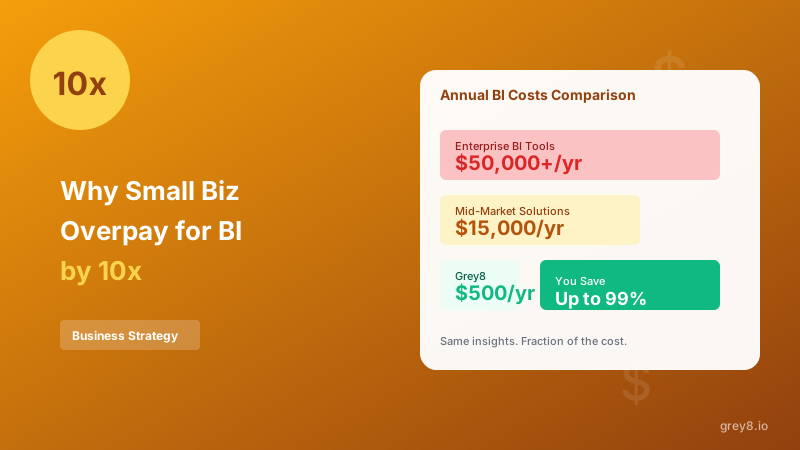
A small e-commerce business doing $2M in annual revenue doesn't need the same BI stack as Walmart. But when they go shopping for business intelligence tools, they're quoted the same enterprise prices—just scaled down slightly.
The Uncomfortable Truth: You're paying for features built for Fortune 500 companies that you'll never use. The BI industry optimizes for enterprise contracts, not small business value.
The Enterprise BI Tax
Enterprise BI tools like Tableau, Power BI, and Looker were designed for companies with dedicated analytics teams, complex data governance needs, and multi-departmental reporting requirements.
Here's what you're paying for that you probably don't need:
Row-level security across 50 departments: You have 12 employees. Everyone can see the same dashboards.
Custom semantic layers: Your data model fits in a spreadsheet. You don't need a PhD in data modeling to understand "revenue by month."
Enterprise support contracts: A $12,000/year support plan for software that costs $8,000/year to license. You're paying more for support than the product.
Professional services for implementation: That $30,000 "quickstart package" is teaching you features you'll never use.
The Hidden Costs Nobody Mentions
The sticker price is just the beginning. Here's where the real costs hide:
Implementation Time
Enterprise BI tools take 3-6 months to implement properly. That's 3-6 months of paying for software you're not using while your team learns a complex interface designed for data analysts.
Training and Expertise
Your marketing manager doesn't want to learn DAX formulas or LookML syntax. They want to know which ads are working. But enterprise tools require specialized training—either hire an analyst or send your team to $2,000 certification courses.
Real Example: A client spent $15,000 on Tableau Desktop licenses and another $8,000 training their team. After 6 months, only one person could actually build dashboards. The ROI timeline extended from 6 months to 3 years.
Data Pipeline Dependencies
Enterprise BI tools assume you have a data warehouse. If you're pulling from Stripe, QuickBooks, and Google Ads—you need ETL tools like Fivetran ($500-2000/month), a data warehouse like Snowflake ($500+/month), and dbt for transformations (free but requires engineering time).
Suddenly your $500/month BI tool costs $3,000/month in infrastructure before you've answered a single business question.
Maintenance and Updates
Dashboards break when schemas change. Someone needs to maintain them. That's 5-10 hours per month of ongoing work—either internal time or consultant fees.
What Small Businesses Actually Need
Let's be honest about what a $1M-$10M business actually needs from BI:
5-10 core dashboards: Revenue, customer acquisition, product performance, cash flow, marketing ROI. Not 500 departmental reports.
Real-time or near-real-time data: Daily updates are fine. You don't need millisecond latency.
Pre-built metrics: You want MRR, CAC, LTV calculated automatically. You don't want to debug SQL to get customer churn rate.
One-click integrations: Connect Stripe in 60 seconds, not 60 days.
Answers, not tools: You need "Why did revenue drop 15% this week?" not a blank canvas to build your own investigation.
The Shift: The next generation of BI tools is purpose-built for small businesses. They trade enterprise flexibility for small business speed and cost-efficiency.
The New Economics of BI
Modern BI tools are challenging the enterprise pricing model with fundamentally different economics:
Vertical-specific solutions: A BI tool built specifically for e-commerce or SaaS comes with pre-built dashboards and metrics. Implementation drops from months to hours.
Embedded data pipelines: When the BI tool handles data integration natively, you don't need separate ETL tools and data warehouses. Your stack complexity drops by 70%.
AI-powered insights: Instead of building dashboards to find anomalies, AI surfaces them automatically. "Your Facebook ad spend efficiency dropped 40% yesterday" appears in your inbox without you building a monitoring dashboard.
Consumption-based pricing: Pay for data volume or user seats, not for features you'll never use. A 5-person company shouldn't pay the same base price as a 500-person company.
Taking Action
If you're currently overpaying for enterprise BI, here's your migration path:
Audit your current usage: Which dashboards do you actually check weekly? Which features do you actually use? You'll probably find you're using 10% of what you're paying for.
Define your actual requirements: What questions do you need answered? What data sources matter? Don't let a vendor tell you what you need.
Explore modern alternatives: Tools like Grey8, Metabase, and vertical-specific solutions are purpose-built for small businesses. They cost 10x less and deliver results 10x faster.
Calculate true TCO: Don't just compare license costs. Include implementation time, training, infrastructure, and maintenance. The cheapest sticker price is often the most expensive in reality.
Warning: Switching BI tools is disruptive. But so is paying $2,500/month for dashboards nobody looks at. Calculate the switching cost against 12 months of overpayment.
The BI market is changing. Small businesses finally have options built for their needs, their budgets, and their teams. The enterprise tax is optional.