Most businesses start with Stripe webhooks and a Google Sheet. Then they graduate to nightly CSV exports. But when you need real-time revenue analytics, cohort analysis, or multi-source attribution—you need a real data pipeline.
The Reality: Building a production-grade data pipeline isn't just about moving data from point A to point B. It's about handling the 100 edge cases that only appear at 3am when your biggest customer churns.
The Anatomy of a Real-time Pipeline
A production pipeline has five critical components that amateur implementations often skip:
1. Event Capture: Stripe webhooks are your source of truth, but they're unreliable. You need webhook retry logic, dead letter queues, and idempotency keys to guarantee exactly-once processing.
2. Stream Processing: Whether you use Kafka, Pub/Sub, or EventBridge, you need a buffer between webhook receipt and data warehouse insertion. This decouples ingestion from transformation.
3. Transformation Layer: Raw Stripe events are nested JSON nightmares. You need to flatten, denormalize, and enrich them before they hit your warehouse. This is where dbt or custom Python lives.
4. Data Warehouse: BigQuery, Snowflake, or Redshift. Pick your poison. The warehouse needs partitioning, clustering, and proper schema design or your queries will cost more than your Stripe fees.
5. Monitoring & Alerting: When the pipeline breaks at 2am, you need to know within 5 minutes. Data freshness SLAs, error rate alerts, and data quality checks aren't optional.
Case Study: Stripe to BigQuery
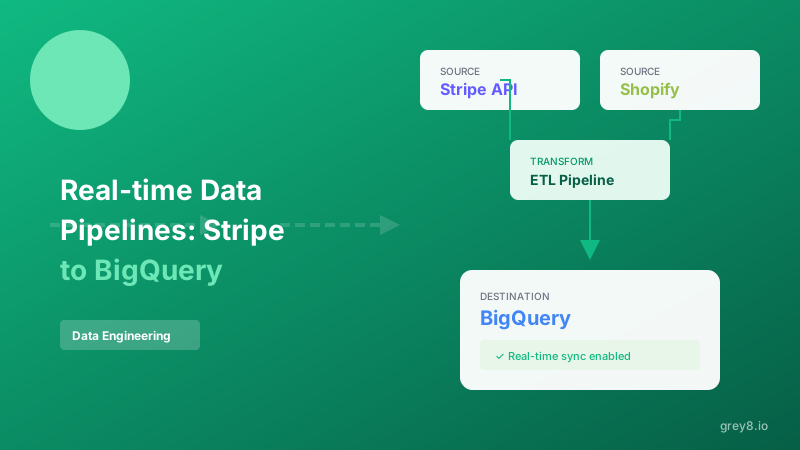
We recently built a real-time pipeline for a Series A SaaS company processing $2M ARR through Stripe. Here's what the architecture looked like:
The stack: Stripe webhooks → Cloud Run → Pub/Sub → Dataflow → BigQuery. Each component chosen for reliability and cost-efficiency at their scale.
Key Decision: We chose Dataflow over Cloud Functions for transformation because it handles backpressure gracefully. During their Black Friday sale, webhook volume spiked 10x—Dataflow auto-scaled without dropping events.
Handling the Hard Parts
The difference between a demo pipeline and a production pipeline is how you handle the edge cases:
Idempotency
Stripe will resend the same webhook multiple times if your endpoint is slow or times out. Without idempotency keys, you'll double-count revenue. We use BigQuery's MERGE statement with event IDs as the deduplication key.
Late-Arriving Data
A customer upgrades on December 31st, but the webhook arrives January 2nd due to retry delays. Which month does that expansion MRR count toward? Your pipeline needs watermarking and late-data handling policies.
Schema Evolution
Stripe adds new fields to their events quarterly. Your pipeline needs to handle schema changes gracefully without breaking downstream dashboards. We use schema inference with backward compatibility checks.
War Story: A client's pipeline broke when Stripe added a nested 'payment_method_details' object to charge events. Their rigid schema rejected the new structure, dropping 48 hours of data before anyone noticed.
Backfill Strategy
You'll need to backfill historical data. But Stripe's API rate limits mean you can't just bulk-import 3 years of charges. You need incremental backfill logic that respects rate limits and checkpoints progress.
Cost Optimization
A poorly optimized pipeline can cost more than the insights are worth. Here's where costs hide:
BigQuery Storage: Partition by day, cluster by customer_id. One client reduced query costs by 90% just by fixing their partitioning strategy.
Dataflow Workers: Auto-scaling is convenient but expensive. Set max workers based on your actual peak load, not theoretical maximums.
API Calls: Stripe charges per API request. If you're enriching events with additional API calls (like fetching customer metadata), cache aggressively. We reduced API costs by 80% with a Redis cache layer.
Pro Tip: Use BigQuery's free tier strategically. The first 10GB of storage and 1TB of queries per month are free. For early-stage companies, that's often enough.
Build or Buy?
Here's the uncomfortable truth: building a production pipeline costs 200+ engineering hours upfront, plus 10-20 hours per month in maintenance.
For a senior engineer at $150/hour, that's $30,000 in the first year alone. Fivetran charges $100-500/month for the same result.
Build if: You have complex transformation logic, need sub-minute latency, or are processing sensitive data that can't leave your VPC.
Buy if: You want Stripe data in BigQuery and don't have unique requirements. Modern ETL tools are 95% of what most businesses need.
Hybrid approach: Use Fivetran for the ingestion, then add custom dbt transformations for business-specific logic. This is what we recommend for most mid-market companies.
The Reality Check
Real-time data pipelines are table stakes for data-driven businesses. But "real-time" doesn't mean you need to build Kafka clusters and Spark jobs.
For most businesses, "real-time" means "fresh enough to make decisions before the opportunity passes." That might be 60 seconds. It might be 10 minutes. Define your actual SLA before you architect for nanosecond latency you don't need.
The best pipeline is the one that ships. Start simple, monitor ruthlessly, and optimize when you have real data on where the bottlenecks are.